
AI transcript of Green Drinks talk by Scott Kuykendall, the Water Resources Specialist for McHenry County follows.
Below is a polished, article-style summary of Scott’s presentation. .The Friend of McHenry County Blog has reorganized the material into logical sections, removed conversational interruptions, corrected transcription errors, and preserved the key technical points and conclusions.
Understanding Data Centers and Water Resources:
What McHenry County Residents Need to Know
Presentation by Scott Kuykendall, Water Resources Specialist, McHenry County Department of Planning and Development
Introduction
Data centers are rapidly expanding across the United States, driven largely by the explosive growth of artificial intelligence (AI), cloud computing, streaming services, and digital infrastructure. While these facilities are often promoted as engines of economic development, they also bring significant demands for water and energy.
As communities throughout Illinois consider proposals for large-scale data centers, residents and local officials must understand how these facilities operate, how they consume resources, and what questions should be asked before approvals are granted.
The purpose of this presentation was not to advocate for or against data centers, but rather to provide factual information that helps communities make informed decisions.
Why Water Matters
Water is fundamental to all life. In fact, when scientists search for life elsewhere in the universe, the first thing they look for is evidence of water.
Water is also the foundation of economic development. Businesses and residents are unlikely to invest in communities that lack reliable, affordable, and clean water supplies.
Despite its importance, water is often overlooked during land-use planning and development decisions decisions that can affect water resources.
Where Illinois Gets Its Water
Illinois relies on several different water sources:
Lake Michigan
Many communities in northeastern Illinois receive water from Lake Michigan. However, Illinois does not have unlimited access.
The state’s allocation is governed by a Supreme Court decree, which limits withdrawals to approximately 2 billion gallons per day. Roughly half of that allocation is already dedicated to stormwater diversion, leaving about half available for drinking water.
Lake Michigan is therefore not an infinite resource.
Shallow Sand and Gravel Aquifers
Much of northern Illinois depends on groundwater stored in sand and gravel deposits left behind by glaciers.
These aquifers are considered renewable because they recharge through rainfall and snowmelt. However, they can be depleted if pumping exceeds recharge rates.
Sand and gravel aquifers are the main aquifers used for private wells in McHenry County and most of the municipalities in the county draw some, or all, of their drinking water from these aquifers.
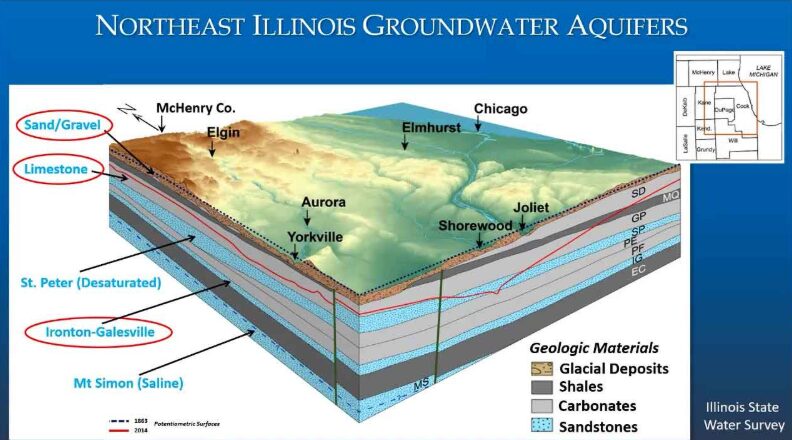
Dolomite Aquifers
Water can also be stored within cracks and fractures in limestone and dolomite bedrock. Many private wells rely on these formations.
Deep Sandstone Aquifers
Many municipalities in the region also draw water from deep sandstone aquifers, including the Ironton-Galesville formations.
Unlike shallow aquifers, these systems recharge extremely slowly. Some water entering these formations today may take over 1,000 years to reach Illinois.
As a result, deep sandstone aquifers are effectively nonrenewable on human timescales.
McHenry County’s Water Monitoring Program
McHenry County has invested heavily in understanding its groundwater resources.
The county maintains a network of 37 monitoring wells that record groundwater levels every 15 minutes. Data has been collected continuously since 2009 and is available to the public through:
McHenryH2O.com
This monitoring allows scientists to understand how:
- Droughts affect groundwater
- Development influences aquifer levels
- Climate patterns impact water availability
One monitoring well near Wonder Lake illustrates how even a single subdivision can significantly influence groundwater levels through irrigation demands.
The Growing Concern: Data Centers
Modern data centers are no longer small facilities.
Today’s hyperscale data centers can occupy hundreds or even thousands of acres.
They require three critical resources:
- Fiber optic connectivity
- Massive amounts of electricity
- Significant quantities of water
Unlike many industries, data centers operate:
- 24 hours a day
- 7 days a week
- 365 days a year
There is no downtime.
Direct vs. Indirect Water Use
One of the most misunderstood aspects of data centers is water consumption.
Scott emphasized the importance of separating:
Direct Water Use
Water consumed within the facility itself, primarily for:
- Cooling computer equipment
- Fire suppression
- General building operations
Cooling accounts for the overwhelming majority of direct water use.
Indirect Water Use
Primarily represents water used elsewhere to generate electricity.
This includes water consumed by:
- Coal power plants
- Natural gas plants
- Nuclear facilities
The water is used to generate steam to power turbines that create electricity and to provide cooling for the power plants.
In many cases, indirect water use accounts for roughly 80% of the total water footprint associated with a data center.
Power plants are usually located far from data centers, so indirect water is usually drawn from a different source than the sources that provide direct water use.
Failure to distinguish between these categories often leads to confusion and misleading public discussions.
Why Cooling Matters
Computer processors generate enormous amounts of heat.
Without cooling, they would quickly fail.
The way a facility removes heat largely determines its water consumption.
Cooling Technologies
1. Evaporative Cooling
This method sprays water into the air.
As the water evaporates, heat is removed.
Advantages:
- Lower energy costs
Disadvantages:
- Very high water consumption
2. Free-Air Cooling
Outdoor air is filtered and brought directly into the facility.
Most effective when temperatures range between:
41°F and 64°F
Advantages:
- Minimal water use
- Lower operating costs during cool weather
Limitations:
- Only effective under certain climate conditions
3. Closed-Loop Liquid Cooling
Liquid circulates through a sealed system and carries heat away from processors.
Advantages:
- Much more efficient than cooling entire rooms
Challenges:
- Requires chemical additives
- Raises wastewater disposal concerns
Common additives include:
- Glycol
- Biocides
- Scale inhibitors
Improper disposal could negatively affect wastewater treatment systems.
4. Two-Phase Cooling Systems
Special dielectric fluids boil at very low temperatures.
The fluid vaporizes, removes heat, then condenses back into liquid.
Advantages:
- Extremely efficient
- Little or no water use
Concerns:
- Often contains PFAS-related compounds
- Potential environmental risks remain unclear
5. Liquid Immersion Cooling
Servers are completely submerged in specialized cooling fluids.
Advantages:
- Exceptional heat removal
- Allows greater computing density
Challenges:
- High cost
- Often contains PFAS-related compounds
The Water-Energy Tradeoff
A key takeaway from the presentation:
Water efficiency and energy efficiency often work against each other.
Systems that minimize water use frequently require more electricity.
Systems that reduce electricity demand often consume more water.
Communities must understand these tradeoffs before evaluating proposals.
Energy: The Bigger Challenge
According to Scott, energy may ultimately be a larger concern than water.
Data centers require enormous quantities of electricity. Since the heavy energy demands of data centers can significantly increase energy costs for the public and impact energy supplies, pressure for data centers to produce energy onsite is increasing.
Traditional power generation relies heavily on water. When energy is produced on or near the data center properties, the direct water use and indirect water use will likely be withdrawn from the same water sources.
Whether electricity comes from:
- Coal
- Natural gas
- Nuclear power
the process usually involves boiling water to generate steam.
That means increased electricity demand often leads to increased water demand.
Future Energy Sources
Natural Gas
Currently the most common solution.
Challenges include:
- Long equipment lead times
- Significant water requirements
- Greenhouse gas emissions
Small Modular Nuclear Reactors (SMRs)
Frequently promoted as the future of clean energy.
However:
- None are currently operating commercially in the United States
- The technology remains largely experimental
Questions remain regarding:
- Water use
- Safety
- Regulatory oversight
Hydrogen Systems
Hydrogen is increasingly discussed as an energy solution.
However:
- Hydrogen is primarily an energy storage medium
- Producing hydrogen often requires more energy than it yields
Solar and Wind
These technologies use very little water.
However, large-scale deployment requires substantial land.
Communities must decide whether dedicating large areas to energy production for data centers is the best use of local landscapes.
Transparency Is Essential
One of Scott’s strongest criticisms was the lack of transparency surrounding data center proposals.
There is currently:
- No standardized water reporting system
- No standardized comparison methodology
- Limited public access to operational data
As a result, communities often struggle to understand the true impacts of proposed facilities.
Key Questions Communities Should Ask
Rather than relying on slogans or exaggerated claims, Scott encouraged residents to ask informed questions:
Water
- How much direct water will be used?
- How much indirect water will be used?
- What aquifer or water source will supply the facility?
- Will water use increase as AI demand grows?
Cooling
- What cooling technology will be used?
- Is it evaporative, mechanical, or closed-loop?
- What chemicals are involved?
Energy
- Where will electricity come from?
- Will on-site power generation be used?
- How much water will energy production require?
Wastewater
- How will wastewater be handled?
- Can treatment plants safely process discharges?
Long-Term Monitoring
- Will water use be tracked after approval?
- What safeguards exist if resource consumption increases?
Final Message
Scott’s overall message was not that data centers should be banned.
Rather, communities must recognize that data centers represent a new and rapidly evolving technology with significant resource demands.
Local governments are often the only line of oversight because federal and state regulations have not kept pace with the industry’s growth.
The most effective response is not fear, politics, or confrontation.
It is education.
Communities that understand how these systems work are far more likely to ask the right questions, obtain accurate information, and make decisions that protect both economic opportunity and long-term environmental sustainability.
