
Today I found a long Fox News story featuring Prairie Grove’ proposed Battery Farm.
Here is the summary:
- A proposed 600-megawatt battery storage project could generate up to $5 million in annual tax revenue for McHenry County.
- Supporters say the Monarch Grid project could help stabilize the power grid and provide financial relief for Prairie Grove District 46.
- Neighbors remain concerned about fire risks, environmental impacts and the loss of local control over the project.
That prompted me to listen to the last Prairie Grove District 46 Grade School Board’s budget meeting. (It’s on YouTube.)
Business Manager Joseph Bailey presented and explained the budget information, concluding by saying, “It’s a pickle.”
That is a massive understatement.
The current school board has inherited a real mess.
About four years ago, the Board issued what are called lternative Revenue Bonds (which didn’t require voter approval).
$9 million.
The District 46 has to allocate $700,000 per year to repay the principal and interest throiugh thr year 2044!
(I think that’s the first time I have used an exclamation mark in a story.)
Two years ago in a tip of the hat to homeowners, the Board took only half of the increase in money allowed by the Tax Cap.
Unusual for school districts, it did not tax to the max.
Bailey took the standard view, as he explained D46 would be losing $600,000 to $700,000 (compounded)…forever.
From a taxpayer’s point of view, of course, that $600,000 to $700,000 a year will remain in their checking accounts.
Then in 2024, the school board borrowed another $13 million in non-referendum revenue bonds, which, Bailey said, “put us severely underwater.
“We have a structural deficit.
“There’s nothing we can do about it except address it…Every year it easts away our fund balance…out savings account.
“Unfortunatley, this is the last year weare going to have savings in our savings account.”
The $17-18 million in next year’s real estate taxes are “already allocated.”
At this point one of the male Board members interjected, “Unless those are addressed, I don’t think you got chance of passage (of aswa referendum).”
As with mosrt school districts, about 80% of the budget goes for salaries and fringe benefits.
At the rate of current spending, the district is in the hole $1.5 to $2 million per year, Bailey reported, pointing out that there’s no way to cover the structual deficit.
“We have to do it in a permanent way.”
Budget cuts is one way.
Another to increase revenue through passage of a tax hike reverendum.
“Or a combinatin of both.”
“But we cannot do nothing.”
Contnuing, Bailey explained, “We already have taken every opportunity we can find (in) savings, about $1 million, but it’s (not enough).
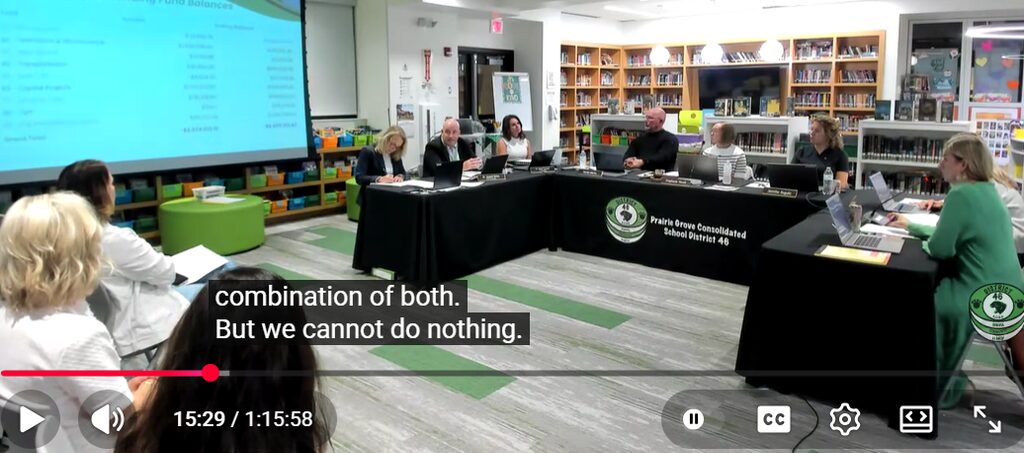
“If we pass a referendum to cover this deficit, we are still going to have to reduce because we are ocverstaffed at the moment in some areas.”
He noted some of the cuts so far:
- reduced staff
- fewrer field trips
- less supplies
A potential recenue increase would be recruiting more “out pre-school kindergarten, which is underutilized.”
That might yield $150,000 to $200,00 per year.
Reimposing fees, which apparenly were eliminated a few years ago, might bring in $200,000 to $300,000, he said.
Another $30,000 might be squeezed (my word) out of suppliers.
And the eleven acres of farmland could be sold.
Regardless, Tax Anticipation Warrants (short term loans that have to be repaid as thenexct year’s property taxes are received) would be needed next year.
Bailey also said the School Board has authorized a forensic audit in the next two months.
“It’s a big ask no matter what we do.”
He added that a community survey would be taken.
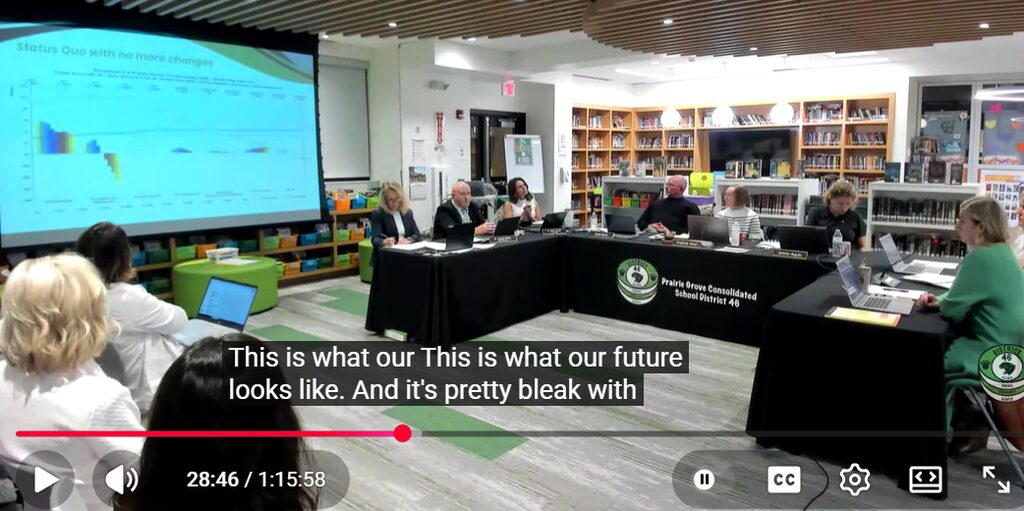
“This is what our future looks like and it’s pretty bleak.
“If we don’t increase revenue and reduce expenditures, you can see where we will be in a couple of years because the state will probalby have taaken us over, if we don’t fix ourselves.”
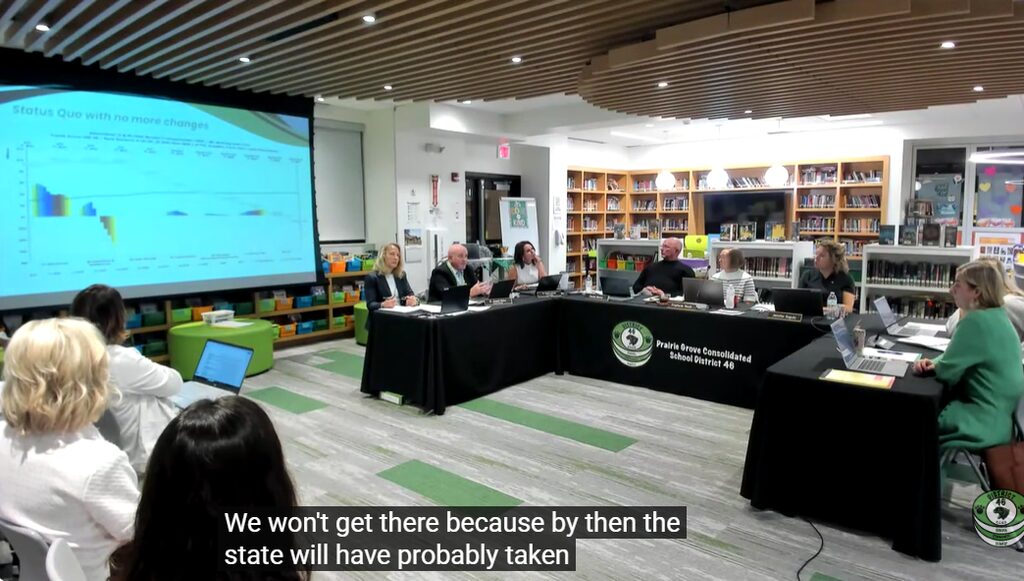
Bailey pointed to Rouund Lake and Cary as examples of what could happen.
Questions were then entertained from Board members and those in the audience.
One male Board member observed, “We know where we are.”
A female Board member asked about a cash flow analysis, which Bailey said was forthcoming.
Then a man in the audience, who had precviously served on the District’s Finance Committee, said he resigned when the tax hike raferendum–advertised for 30 cents, turned out to be 70 cents.
“I thought it was terribly unethical to do that.”
Continuing, he pointed out that a referendum has been defeated, but the Board bought it (the farmland?) anyway.
“And, when a survey was conducted on the bonds, and the survey said, ‘No,’and they took out the bonds.
“In my mind we don’t have a structural deficit problem, we have a structural problem with the power that the Board has with the community’s money…
“The history of this Board in this community is a terrible one.
“And I’m sure you get that frm the people.”
Comenting on a potential tax hike referendum, he said, “I don’t think y ou have a chance to pass anuything.
“I’m certainly not going to vote for anything because we’ve been down that road.”
A woman in the audience added, “I’m personally opposed to the referendum”
She suggested perhaps one might pass if it had a time limit on the tax increase.
