
From the campaign of Collin Corbett:
Collin Corbett Releases a Real Plan for Property Tax Relief in Illinois
Collin Is the Only Gubernatorial Candidate to Tackle the Property Tax Crisis Head On with Real, Structural Solutions That Will Deliver Relief for Working Families
PALATINE, IL — Independent candidate for Governor Collin Corbett has released his plan to deliver property tax relief for Illinois working families through real, structural solutions that tackles the crisis head on.
“The single biggest challenge for working families in Illinois is affordability, with sky-high property taxes at the top of the list,” said Collin.
“Our property tax rates are more than double the national average and nearly triple rates in Indiana.
“There is no easy fix, but we must start now before this property tax crisis spirals even more out of control.”
In Collin’s property tax plan, available on his website, he points to the state underfunding schools, unfunded mandates, LGDF cuts, excessive local governments, legacy pension debt, and a stagnant economy as the root causes of our sky-high property taxes.
And he says that neither of the major party candidates are offering solutions to this crisis.
“On one extreme, we hear Pritzker repeatedly claim crushing property taxes are not his fault, and point his finger at local leaders.
On the other extreme, Darren Bailey is promising an immediate 1% property tax cap, even though the Governor has no authority to impose one,” Collin said.
“Unlike our opponents, Carolyn and I are the only candidates with a plan to finally deliver property tax relief for Illinois working families.
“Maybe it’s because we’re not billionaires or millionaires—we know the weight of a mortgage and property taxes.”
Collin’s five-point property tax plan:
1) Reduce Unfunded Mandates: We will revive the bipartisan idea for an “Office of the Repealer” focused on eliminating outdated, redundant, and overly burdensome regulations and mandates. In addition, we will establish a three-tier system for all existing and future mandates. Tier 1 would be core, mandatory standards covering civil rights, life-safety, and health requirements. Tier 2 would be model best practices for which Springfield provides grant funding or technical assistance when local governments choose to opt in. Tier 3 would be fully discretionary.
2) Fully Fund Schools and LGDF: We will freeze discretionary state spending, put in place transparent accountability standards, and cut funding for ineffective or outdated programs. We will also modernize our state’s regressive sales tax system. [See below.] By holding state spending in check, additional revenues from growth and retiring bonds in 2030 and 2033 can be invested into fully funding K-12 education and LGDF. These new state dollars will be tied to incentive programs that reward local taxing bodies for directly reducing their property tax levies.
3) Restore Pension System Solvency: The third area we will invest as we restore fiscal responsibility to Springfield is paying down the state’s legacy pension debt. We will protect taxpayers by preventing new Tier 2 benefit sweeteners, beyond federal Safe Harbor compliance, until the state reaches fiscal stability. We will also eliminate pension spiking and extend voluntary pension buyout options to local employees. [See below.]
4) Consolidate Excessive Government: We will also work to eliminate inefficiencies by consolidating or eliminating redundant layers of government. This starts with eliminating townships in counties where municipal services already cover the same geographic footprint. It includes eliminating single-purpose special districts like drainage, mosquito abatement, and sanitary districts. And it explores merging single-school elementary districts as well as consolidating high school and elementary districts with overlapping boundaries into unit districts. [See below.]
5) Get Illinois Growing Again: We have a full plan to make Illinois open for business. When this is implemented and our state starts growing again, both in population and GDP, this will expand the tax base, grow revenues for local governments, and shift the property tax burden from our current property owners.
View the full plan at CollinForIL.com/PropertyTaxes. Collin explained the entire plan in detail on his Live from the Lincoln Desk livestream this week, viewable here.
= = = = =
First, “LGDF” refers to the portion of income tax given to municipalities and counties.
Second,. merging elementary school districts would probably save money, but merging elementary school districts with their high school districts into unit school districts won’t. The reason is that a new combined union will be controlled by grade school teachers because there are more of them than high school teachers. That means when the first contract is negotiated, the grade school teachers will demand they be paid as much as the higher-paid high school teachers. So, instead of a property tax decrease, more real estate taxes will be required to pay for the salary hikes. It is delusiional to think equalization would come from high school teachers earning less.
Third, eliminating only townships in counties where municipal services already cover the same geographic footprint and special districts will probably resuult in some reduction in property tsxes, but, remember, school real estate taxes comprise most of one’s bill. And, if the elimination only covers those townships where all of a township overlaps a municipality, virtually none will disappear. In McHenry County, I know of no township which is covered by muncipal boundaaries.
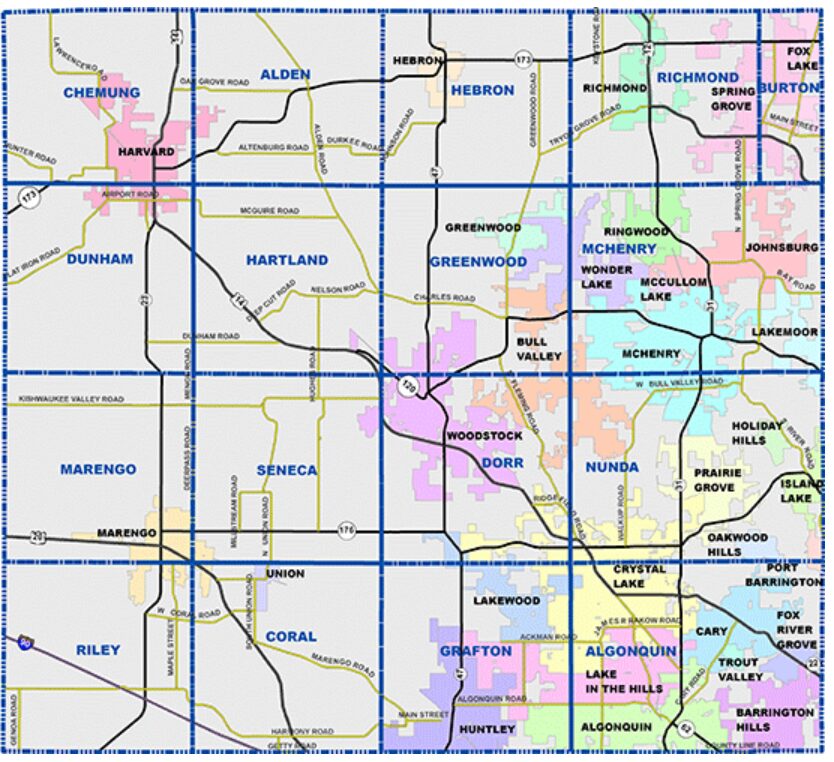
Algonquin Township is the only McHenry County township that comes close to meeting Corbett’s criterion.
Third, Corbett talks of modernizing the state sales tax. Here are details supplied by the campaign: “I’td include broadening the base to include non-essential services, lowering the baseline sales tax rate to help working families, and eliminating the sales tax on everyday essentials like groceries, baby formula, diapers, medicine and medical supplies, and school supplies.” There is no state sales tax on groceries. The Democrats voted to kill it, the result being that many local municipaliles voted to impose the same amount the state took off.
Fourth,I see no connection of the state’s pension debt with property taxes.
