
From Terri Rybicki:
The Battery Bailout: Is Prairie Grove CSD 46 Trading Safety for Solvency?
Recent discussions at Prairie Grove school board meetings have exposed a disturbing trend in our district’s financial strategy.
If you haven’t watched the meetings firsthand, you are missing a masterclass in how to commit taxpayers to millions in debt without ever asking for their permission.
From my perspective, the district is under crushing financial pressure, much of it seemingly self-inflicted.
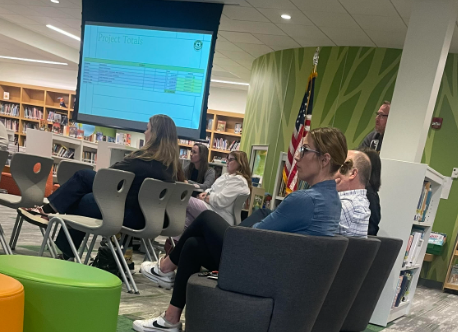
Prairie Grove School Board meeting on April 21, 2026. In attendance was Prairie Grove Village President David Underwood, but he is seen on the right standing next to the column..
Let’s be clear: the community explicitly asked for a vote on the recent school addition. Instead of a transparent referendum, the board moved forward anyway.
Now, residents are left to wonder if those unchecked spending decisions are exactly what led us to the “crisis” we are seeing today.
The most glaring evidence of this “referendum avoidance” strategy is the district’s reliance on Alternative Revenue Bonds.
For those who don’t follow the jargon, these are essentially “backdoor” bonds.
They allow the district to borrow massive sums without a direct public vote, betting that some future revenue—like the controversial Monarch Grid lithium battery project—will show up to pay the bill.
But here is the catch: if that revenue doesn’t materialize, you, the taxpayer, are still on the hook for the debt.
= = = = =
This is exactly what happened in Lakewood when the village voted to use Alternative Revenue Bonds and golf course revenues fell far, far short, costing the Skinner family an extra $500 a year for fifteen of the twenty years of the bond repayment. If you thinkI’m still smarting over that, you are right.
= = = = =
This raises a serious question for the community: Is the lithium battery project being presented as a “benefit,” or is it actually a desperate necessity to cover up a bond strategy that bypassed the voters?
Supporters view the battery project as a revenue savior, potentially bringing in $2.2 million for the school.
But at what cost?
In my opinion, it is entirely reasonable to ask if the district has backed itself into a corner where it has to support a project the community clearly opposes just to keep the lights on.
We’ve seen what happens when these “solutions” go wrong.
In Warwick, NY, similar battery sites have faced multiple fires, leading to local condemnation orders and safety lockdowns.
If Prairie Grove experiences similar issues—or if the project causes property values to drop and enrollment to decline—the resulting impact on school funding would be a disaster.
Ultimately, this is about the death of transparency.
Are these financial maneuvers truly the best path forward, or are they high-stakes gambles designed to avoid the one thing the board seemed to fear most in the past : a public referendum?
Taxpayers and parents deserve to know if they are being silenced by design.
The decisions being made now will shape Prairie Grove for decades. Only time will tell if this “backdoor” strategy pays off—but the community deserves clear answers before the bill comes due
