
I’ve been looking at Coefficients of Dispersion for pretty much sixty years.
This is a measure of the uniformity of assessments in a given jurisdiction a member of the Illinois Department of Revenue pointed me to in the late 1960’s when I decided to look at assessment disparities while I was County Treasurer.
My stimulation was a woman who came into to pay her taxes complaining a house build before hers across the valley was assessed as an empty lot, while hers was assessed at 60% of what she had paid for it.
After she left I went downstairs to the Supervisor of Assessments office (now part of a restaurant) to talk to the Supervisor of Assessments Stanley Cornue. He had been appointed after a law had been passed allowing County Boards to create the office, which meant the County Treasurer would no longer perform that function.
I explained the woman’s complaint to Cornue.
His reaction was “I don’t work for you.”
“That’s right, Stan, but I’m going to keep asking questions
I later reasoned that the motivation was that setting assessments offered a really good opportunity to solicit/accept bribes.
And, what led me there?
When I went to my first Illinois County Treasurer’s Association meeting after the election, I asked one of the old timers why Sheriffs and Treasurers were limited to one term, not being allowed to run for re-election.
The answer was revealing.
I was told that in 1870 when the Constriction was written the delegates figured that if a Sheriff or Treasurers couldn’t get rich in one term, they were probably too incompetent to serve a second.
Sorry to ramble.
Inspiring this article was a long Chicago Tribune story on the Democratic Party primary race for Assessor.
Within the story was a link to a University of Chicago study of Cook County Assessments.
Within was the following information on Coefficients of Dispersion:
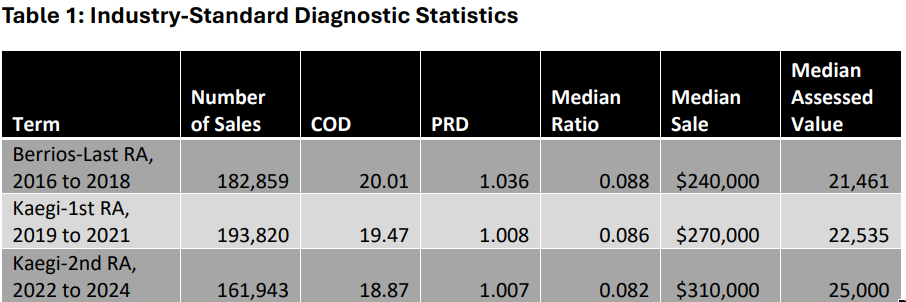
Underneath was this information on COD’s:
“The CoeFicient [sic] of Dispersion (COD) is a measure of assessment uniformity, or horizontal equity. It is the average absolute percentage diYerence from the median sales ratio. For instance, a COD of 10 means that properties have ratios that on average deviate by 10 percent from the median ratio. The IAAO specifies that the acceptable range for COD is below 15. Cook County has been above the acceptable range throughout, but there have been steady improvements under Kaegi.”
Another measure is alsll described:
“The Price-Related DiFerential (PRD) is a measure of regressivity, or vertical equity. A PRD of 1 indicates, loosely, that high- and low-priced homes are assessed at the same rate. A PRD greater than 1 indicates that less expensive homes are assessed at higher rates than more expensive homes, while a PRD less than 1 represents the opposite situation. The IAAO specifies that the acceptable range of PRD is .98 to 1.03. The PRD was just above the acceptable range under Berrios (i.e., regressive) but has been brought into compliance under Kaegi.
“Note that while fairness has clearly improved under Kaegi, accuracy has not improved, and in fact appears to have declined slightly. The median residential assessment ratio has declined from 8.8% under Berrios to 8.6% under Kaegi’s first term and to 8.2% under Kaegi’s second term. In other words, residential properties are increasingly underassessed on average.”
Now, let’s compare the results in McHenry County.
Remember the COD for Cook County is 18.9%.
Here are McHenry County’s results for 2024:
County: 12.60%
- Algonquin: 10.59
- Burton: 11.76
- Chemung: 22.01
- Coral: 15.41
- Dorr: 14.15
- Grafton: 9.57
- Greenwood: 12.65
- Hebron: 18.23
- Marengo: 20.90
- McHenry: 14.82
- Nunda: 12.11
- Richmond: 14.22
- Riley: 15.36
- All others (Alen, Dunham, Hartland, Seneca): 19.05
How bad is a 10% COD?
Let me use a sales tax analogy, assuming the sales tax is 5%.
If three people bought $100 worth of groceries and the first one was charged $104, the second $105 (the correct amount) and the third $106, what do you think would happen?
That’s how bad, assessments in the most uniformly assessed townships (Grafton and Algonquin) are.
